Tonight I came across the most amazing thing. It's called Zooniverse. I saw a link on facebook sharing the Andromeda Project (about), where you can actually go through the images of the Andromeda Galaxy and label star clusters, distant galaxies and picture errors for the astronomers.
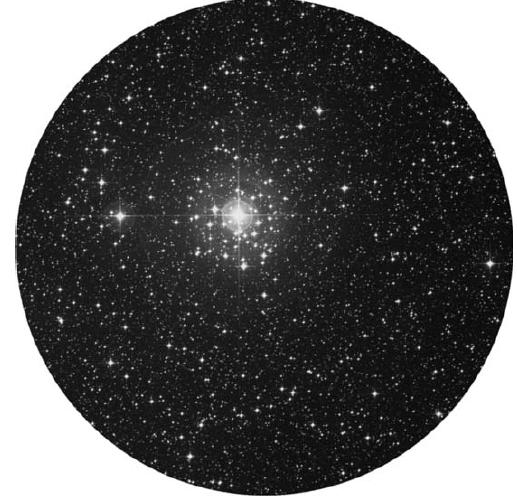
For those who have been out at the observatory with me, you probably know that Open Clusters are my favorite deep sky objects. This is my personal favorite that I've observed:
The point is to go through the images and help label clusters and points of interest or irregularities for the scientists. The tutorial was quick and fairly easy, they also have an added guide to help with tricky identifications and a forum (called Talk) to connect with other users.
I'm excited about this projects because of my passion for clusters, but also because it helps me give back to the researchers.
On the Zooniverse website they have 13 different science projects that you can choose to help. A majority of the projects are Astronomy based, but they also have 4 biology (3 nature, 1 health), 2 Climate and 1 Humanities projects. Also they have 3 different lab projects, 2 space and one humanities. Although one of the space one is about marine life, so it's a mix.
I plan on trying out each one and reporting back to you.
Also if you would like see what I've done in the Zooniverse suite, I have claimed the user name AskAlisonScience. I'm not sure exactly what the mechanisms are for looking at user profiles yet, but if you join and can look me up, that's my name.
Keep Learning!
Alison
Each post I will choose a topic to discuss from some area of science. Mostly I will focus on physics and astronomy, though any interesting topic is fair game. To learn more about me and my blog please check the About Me section.
Showing posts with label science news. Show all posts
Wednesday, December 5, 2012
Wednesday, September 19, 2012
What exactly is a Higgs?
When someone hears of the higgs search what do they think of? Black holes maybe. We all remember the rumors that the Large Hadron Collider (LHC, a particle accelerator that was built to find the Higgs particle and conduct many particle physics experiments) creating black holes and causing a panic. Well don't worry you can always check the webcams. Okay, so that's a joke, but it's amusing to me. Really if you want to know if we are okay, you should check this site. You can refresh it as much as you want.
But back to the point.
Origins (a National Science Foundation funded website committed to communicating advance science to the public) has a wonderful explanation on the Higgs Boson particle and field. As they outline it was the question "What is mass?" that lead to the search for the Higgs particle/field. We think of mass as being inherent to all matter, so how, why would we need something to explain mass? Well in science we try to ask the questions that seem easy but turn out are pretty hard. Try to answer the question what is mass. You will probably come up with a circular answer. For example:
What is mass?
Well we know that matter has mass.
Okay, what is matter?
Well matter is what makes up the universe.
And the universe is?
All matter and energy.
Well that brings us back to what is matter, or we could ask what is energy, but we would pretty much end up in circles again.
We try to explain these basic yet very complicated questions much in the same way people try to answer or communicate the idea of love. It can be tangible in a way. We could discuss the biological process of love, but that's not enough for a lot of people. What causes the process to begin anyway, pheromones? Not always. Love is a complex interaction of emotions, which are not easily quantified. But maybe that's a discussion for another day.
Back to the Higgs.
The Higgs particle was predicted by the standard model (and a man named Peter Higgs). The standard model outlines our knowledge of particle physics. It explains the particles we have discovered or predicted and the physical interactions in the universe. How can things be predicted here? Well that includes a lot of theory and math. But I found a good explanation.
Victoria Martin, a former student of Peter Higgs and current researcher at the LHC, gave a wonderful description called the "A Layperson's Guide to the Higgs Boson." Here are the highlights, slightly shortened.
This is where Higgs’ particle comes in. We can’t
figure out why the electron and the quarks have a mass; unless, somehow,
they obtain a mass by interacting in a special way with the so-called Higgs field.
If this Higgs' explanation is correct and this Higgs field really
exists and is present everywhere in the Universe, then one consequence
is that the Higgs field can clump together and form a new kind of
particle. This new particle is Higgs’ particle, which we call the Higgs
boson. To see if Higgs’ theory is really true we will need to find some
Higgs bosons and see if they really do interact with quarks, electrons
and the other fundamental particles we know about."
I only have one final note. On July 31st, 2012 this news was released, and I'll give you the punch line:
"the ATLAS Experiment submitted a scientific paper describing the discovery of a new particle consistent with the Higgs Boson."
Now in science this is going to require a LOT more testing, but it is still pretty exciting. Science is actually a really slow process sometimes, we try to be both optimistic about discoveries and cautious. We have to keep out method in tact and repeat experiments including letting other teams of scientists repeat them. Only after many people have concluded the same things can we truly feel safe making a revolutionary statement. So I present that news with excitement and baited breath waiting for more testing.
I'm going to let it rest here. Let me know if anything need clarification.
Alison
But back to the point.
Origins (a National Science Foundation funded website committed to communicating advance science to the public) has a wonderful explanation on the Higgs Boson particle and field. As they outline it was the question "What is mass?" that lead to the search for the Higgs particle/field. We think of mass as being inherent to all matter, so how, why would we need something to explain mass? Well in science we try to ask the questions that seem easy but turn out are pretty hard. Try to answer the question what is mass. You will probably come up with a circular answer. For example:
What is mass?
Well we know that matter has mass.
Okay, what is matter?
Well matter is what makes up the universe.
And the universe is?
All matter and energy.
Well that brings us back to what is matter, or we could ask what is energy, but we would pretty much end up in circles again.
We try to explain these basic yet very complicated questions much in the same way people try to answer or communicate the idea of love. It can be tangible in a way. We could discuss the biological process of love, but that's not enough for a lot of people. What causes the process to begin anyway, pheromones? Not always. Love is a complex interaction of emotions, which are not easily quantified. But maybe that's a discussion for another day.
Back to the Higgs.
The Higgs particle was predicted by the standard model (and a man named Peter Higgs). The standard model outlines our knowledge of particle physics. It explains the particles we have discovered or predicted and the physical interactions in the universe. How can things be predicted here? Well that includes a lot of theory and math. But I found a good explanation.
Victoria Martin, a former student of Peter Higgs and current researcher at the LHC, gave a wonderful description called the "A Layperson's Guide to the Higgs Boson." Here are the highlights, slightly shortened.
"So what is this particle Higgs invented? We
particle physicists investigate the properties of fundamental subatomic
particles. Just as everything is made of molecules and those molecules
are made of atoms, it turns out those atoms themselves are made of more
fundamental particles: electrons, protons and neutrons. We believe the
electron is a truly fundamental particle: it isn’t built up of smaller
building blocks. However we know that the protons and neutrons are not
fundamental; they consist of three even smaller particles we call
“quarks”.
I only have one final note. On July 31st, 2012 this news was released, and I'll give you the punch line:
"the ATLAS Experiment submitted a scientific paper describing the discovery of a new particle consistent with the Higgs Boson."
Now in science this is going to require a LOT more testing, but it is still pretty exciting. Science is actually a really slow process sometimes, we try to be both optimistic about discoveries and cautious. We have to keep out method in tact and repeat experiments including letting other teams of scientists repeat them. Only after many people have concluded the same things can we truly feel safe making a revolutionary statement. So I present that news with excitement and baited breath waiting for more testing.
I'm going to let it rest here. Let me know if anything need clarification.
Alison
Thursday, September 6, 2012
Top 10...Errr, Top 4.5 Science Links For August
Here are my top 4.5 favorite articles I've read online this past month. With them I've included a brief summary and why I enjoyed it. (Note, they are not really ranked, I enjoyed all of them, so the numbers are just to keep track.) I was going to do top 10, but the month got away from me, with the move. The reason it is 4.5 is because I included another link without comment. Perhaps we could have a discussion about link 4.5? Read it, and let me know if you have any questions.
This article discusses the recent discovery of planets orbiting a binary star system. We've seen this type of system in the movies but this is the first time we have observed multiple planets around a system like this. This discovery was made by the Kepler Mission, a NASA mission to discover exoplanets (planets orbiting other stars. (exo-meaning outside of our solar system) AKA extrasolar planets). Why did I include this? Well not only is this REALLY COOL science, but it pushes our understanding of how a solar system forms.
Remember, science is like cleaning out a closet, the room is going to get messy when you pull all the stuff out of the closet, but in the end everything is better. Asking questions in science is the same way, the answer you think you are going to get is often not there, instead you find more questions which you must then answer.
Why I loved this article is because it highlights an interesting side of science. Basically this: Scientists like small easy to manage problems. Sounds good right? The problem is that the real world is very interconnected, there are a lot of variables that are hard to manage and to measure all of them all the time. This is one reason that the weather report is highly variable. Calling for rain all week? Well it was cloudy Monday... Then it was sunny all week. There are many global variables to track in weather prediction. The same is true for all areas of science. When you get down to real world systems there are truly thousands (if not infinite) of variables to keep track of.
In medicine, not only what the person eats, how much they exercise, what kinds of exercises, bathroom habits, sleep patterns, stress levels, emotional stability, family history, genetics, home life, weather, air quality, levels of communication between the patient and the doctor, etc all effect the delicate balance of human life. It is nearly impossible to always account for all these things when treating someone.
One of my favorite books is A Brave New World and this reminded me of that. I have always found the idea of learning while sleeping fascinating. I love learning and would love to do it around the clock. However learning to sniff when I hear a specific noise isn't what I was going for. That doesn't mean this isn't a cool study, it is very cool. Of course I instantly thought of Pavlov's dog (Pavlovian conditioning) when I read this.
Side note: In A Brave New World they use hypnotic conditioning of children to teach their beliefs while the children are asleep. That's why I thought of it.
Chemical exposure during development can be very complicated. When the embryo's cells are developing they are more reactive than an adult's cells. In the early stages especially when the cell signaling is crucial. From one cell we get millions that end up being sectioned off into to different organ types. This means that from early signals the cells begin to organize and form the first tissues of the babies. This is why chemical exposure can have such a dramatic effect, cells signal each other with chemicals. The likely conclusion here is that the exposure to PFCs stimulates fat storing cell production. Of course this is just my educated guess, I have not done any personal research into this.
So let me know if there are any questions/comments about 4.5 (Or any of them of course). I would love to clear anything up or start a discussion.
What's on tap for this month? Well I plan on doing a Top ten list at the end of the month/beginning of October. Since I have a few Astronomy programs scheduled I will be doing an Astronomy related post. Also, I want to get some serious work done on a particle physics entry that I promised I would write.
Keep your questions coming.
Alison
What's on tap for this month? Well I plan on doing a Top ten list at the end of the month/beginning of October. Since I have a few Astronomy programs scheduled I will be doing an Astronomy related post. Also, I want to get some serious work done on a particle physics entry that I promised I would write.
Keep your questions coming.
Alison
Friday, July 6, 2012
Possible Higgs?!
Possible Higgs
I'm speechless....
How to explain this?
Well, in physics we have something called the "Standard Model" which defines all basic particles in the universe as we know it. The standard model predicted many particles before they were confirmed. The Higgs particle is the only one that has not been found.
This is one of the main reasons we (mankind) built the Large Hadron Collider (LHC). The LHC is a particle accelerator, the largest in the world. The size is important when colliding particles because the particles will have a longer distance to gain more energy before colliding. All other particle accelerators failed to produce the Higgs particle before the LHC. Now the LHC may have found it. As always in science though, more tests are needed to reproduce the results. But this could really mean a lot to the physics world.
I know this explanation is rather weak right now, and I apologize. When I have time I will write a thorough post about the Higgs that I hope everyone can understand.
But before I do that one, I still need to work on that fire blog! I have remembered it. It is coming. Expect it soon!
And as always, feel free to contact me with questions.
I'm speechless....
How to explain this?
Well, in physics we have something called the "Standard Model" which defines all basic particles in the universe as we know it. The standard model predicted many particles before they were confirmed. The Higgs particle is the only one that has not been found.
This is one of the main reasons we (mankind) built the Large Hadron Collider (LHC). The LHC is a particle accelerator, the largest in the world. The size is important when colliding particles because the particles will have a longer distance to gain more energy before colliding. All other particle accelerators failed to produce the Higgs particle before the LHC. Now the LHC may have found it. As always in science though, more tests are needed to reproduce the results. But this could really mean a lot to the physics world.
I know this explanation is rather weak right now, and I apologize. When I have time I will write a thorough post about the Higgs that I hope everyone can understand.
But before I do that one, I still need to work on that fire blog! I have remembered it. It is coming. Expect it soon!
And as always, feel free to contact me with questions.
Subscribe to:
Posts (Atom)