Sections

Showing posts with label learning. Show all posts

Tuesday, February 19, 2013

Q&A: Science Books For Everyone (A List)

Q  Would you put together a recommended reading list for a world citizen in 2013 to be in a good position to judge political and moral claims in the light of science today?


A  I have not read books that I feel really meet your expectations, but I have found some suggestions, I just haven't read them.

1.  The 5 Elements of Effective Thinking by Edward B. Burger and Micheal Starbird
http://www.amazon.com/dp/0691156662
This is a book about working through problems logically which is essential to science education.

2.  The Science of Science Policy by Kaye Husbands Fealing, Julia I. Lane, John H. Marburger III, and Stephanie S. Shipp
http://www.sup.org/book.cgi?id=18746
This book looks promising, but I'm not sure how much it would apply to the world as a whole or if it only focuses on American policy.

3. BEYOND SPUTNIK – U.S. Science Policy in the 21st Century
http://www.amazon.com/Beyond-Sputnik-Science-Policy-Century/dp/0472033069
It is geared towards the US policy, but is supposed to be an intellectually challenging read.

I realize this is only three books, but I'm hoping this helps. 

A few others I would Recommend but may not be what you are looking for

Flatland http://www.amazon.com/Flatland-Romance-Dimensions-Thrift-Editions/dp/048627263X
QED http://www.amazon.com/QED-Strange-Theory-Light-Matter/dp/0691024170
Really I would consider anything by Richard Feynman a suggestion
Also, Neil DeGrasse Tyson and Brain Greene write wonderfully for the public.

This is a small fraction of the books out there of course, let me know if you feel I left out something huge.
Alison

Saturday, January 26, 2013

Q and A: Brains and knowledge

I received this question and I would like to answer it in two ways. First I will reason out an answer, then I will attempt to summarize my answer in a single paragraph based on the research and logic outlined.

Q: Would it be totally impossible to inject much knowledge into the brain using sound waves? Or maybe a laser to beam the information into a piece of machinery in the brain? 

A:The brain itself is not equipped to process sound waves, that is what our ears are for. Sound waves, as I'm sure you are aware, need something to move through just like waves in the ocean. Sound moves through air most commonly, but can also move through water, glass, wood, etc, but each material moves differently. A very dense material, like a metal door, will block out more sound that a less dense material like a wooden door. Air is the least dense state of matter on Earth which is one reason sound moves through it more efficiently than say water. Gas and liquid can both be described as fluid in motion, by this I just mean they move more easily than something solid.  This video has a good explanation for how sounds move through different materials. 

To get sound waves into the brain they would have pass through your skin, muscles, skull and the fluid around your brain. Whenever the waves pass through a different medium it would change the properties of the waves, as explained in the video above.

So even though we can encode waves with date by modifying the properties, the act of sending it through the head to the brain would contaminate the carefully modified data. If we found a way around this change to the sound wave, each attempt would have to be calculated at that point in time with specific measurements taken. Here's why: Everyone's head is going to vary. The thickness of the skin, the density of the muscle and skull, the consistency of the fluid around the brain and of the gray matter itself would all have to be taken into account. On top of that, we are alive so all of those variables are constantly changing for each person. Dehydration could change the density of the muscle or the fluid in the brain (This part is a little fuzzy for me, someone who knows more on the anatomy of the brain may be able to give a clearer picture), how much knowledge you have is going to change your brain, and even your mood could affect the brain's chemistry. What chemicals are present in your brain could change the movement of the wave.

As a clearer example, think of a clear, crisp autumn day, sound carries cleanly through the air. Now imagine a muggy day in the summer after an afternoon of rain, sounds don't carry as far. The air is now filled with water vapor (the humidity is higher) which will change how the sound waves carry through the air.

So my point is the “weather conditions” in your head would directly effect the injection of knowledge using sound waves. Which means while it might be possible, I doubt that it would be feasible. 

Now this is assuming that we can use these modified sound waves to stimulate the brain and some how get it to store or process information from these waves.  This is a huge assumption to even sugest that it could be possible.  But, I am no expert when it comes to the inter-workings of the brain, so with my limited knowledge I think the logical conclusion is it won't work.  
 
As far as using a laser to beam knowledge into the brain, there are several factors to consider.  One, let's assume we have the technology to interface the brain with a computer chip or mini motherboard.
 
Light is a continuous spectrum, from the Radio (low energy, wide waves of light) to gamma  (high energy, tiny waves of light) waves, as seen in the image below.  Lasers typically are created to emit light in the Ultra-Violet (UV) to the Infrared (IR) wavelengths.   This includes the visible spectrum.
 
Light Waves from High energy to Low energy
Let's start with the visible spectrum since that is what we are most familiar with.  Visible light is going to bounce off your skin.  It would not penetrate deep enough to reach machinery in your brain.
So, what about IR?  Well, we experience IR radiation (all light is radiation) in the form of heat.  So if you were to shine an IR laser at your head, you would warm up.  This could potentially interrupt your homeostasis (you're body's "happy" balance), so I'm not sure this would be wise either.


Two down, one to go.  UV?  Let me ask you this, what do we generally associate with UV light?  The sun/sun burns.  We know UV can damage your skin, even cause cancer.  I don't think shining a Laser emitting UV light would be very healthy.


Alright, well with those ruled out, what if we created a laser that emitted light in a different spectra? Let's go through them:
  1. Microwaves? 
    1. Yum cooked brains?  Next Please!  Well, that's really only one wavelength in the Microwave spectrum.  So maybe, we will discuss this.
  2.  Radio
    1.  Radio waves would probably be too large, they pass through us all the time and don't effect us, so this seems the most likely by far, but let's continue.
  3. X-Rays
    1.  You really want to try to limit your exposure to X-Rays.  There is a reason X-Ray technicians don't stand there without protection if you are being X-Rayed so that won't work.
  4. Gamma Rays 
    1. Long term exposure is also very bad for you.  Anything more energetic than Visible light, and you want to limit your exposure as much as possible.

So Radio would really be the safest option let's explore it to see if it would really work.  Radio waves include wavelengths starting at 0.1 meters and up.  There can be Radio Waves the width of a baseball or the width of the Earth.  This means the receiver would have to be that large.  That's why car antennas are long is so they can receive the right signals.  We get radio waves from Jupiter that need 20 foot long antennas.  This means that while it might be possible, your brain may have to be wired to be a receiver.  But wait, what was that I saw?
This is an interesting image of the spectrum. 
Pay special attention to the location of the Microwave Oven.
Notice where the Radio wave spectrum begins (about the size of a baseball) and where the source is under that (The microwave).  That's where the spectrum overlap a bit.  A microwave oven emits a wavelength of about 0.12 meters.  So there may be hazards at this area of the spectrum (Microwaves to small Radio waves) causing heating from the molecules in your brain, much the way a microwave uses water molecules to heat your food.  To learn more about how a microwave works to heat your food I suggest you watch this video (he gets into some more technical part of the microwave, but the section that discusses how the microwave uses water is very well done).  So that is my hesitation of using Microwaves.  Also, fun fact a Maser is a microwave producing laser!
 
I'm not seeing an easy way to work this, unless you had a fiber optic cable that connected the outside world to the machine in your brain, which has many problems associated with that. 


Here's the punch line:
Q: Would it be totally impossible to inject much knowledge into the brain using sound waves? Or maybe a laser to beam the information into a piece of machinery in the brain? 

A: While I hesitate to say "totally impossible" I'm not sure possible would be the right answer either.  The brain is a mysterious organ, having presented many challenges in science, so I do not want to say "impossible" but based on our current understand I would say no, it's not possible, not in the ways you have proposed. The second question proves to be more promising, but only if certain assumptions are made. Assuming we have a good way of hard-wiring the brain with machinery, then there may be a way to convey knowledge into the machine. This is a large assumption.

Wednesday, December 5, 2012

Amazing Project

Tonight I came across the most amazing thing.  It's called Zooniverse.  I saw a link on facebook sharing the Andromeda Project (about), where you can actually go through the images of the Andromeda Galaxy and label star clusters, distant galaxies and picture errors for the astronomers. 

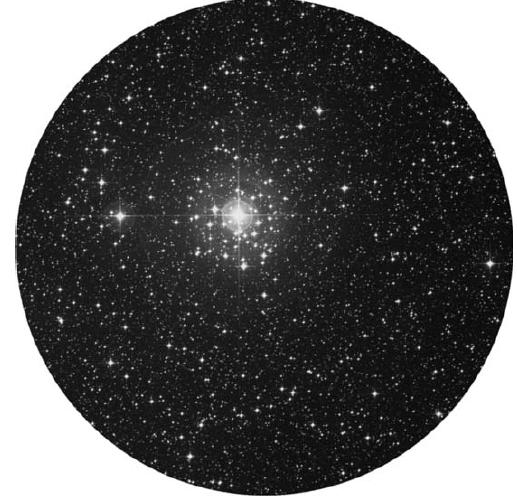
For those who have been out at the observatory with me, you probably know that Open Clusters are my favorite deep sky objects. This is my personal favorite that I've observed:
NGC 2362:  Located in the constellation of Taurus, the first time I found this open cluster the beauty actually took my breath away.  This image cannot fully convey the wonder, but few images could ever attempt to replace looking through a telescope yourself.

The point is to go through the images and help label clusters and points of interest or irregularities for the scientists.  The tutorial was quick and fairly easy, they also have an added guide to help with tricky identifications and a forum (called Talk) to connect with other users.

I'm excited about this projects because of my passion for clusters, but also because it helps me give back to the researchers.

On the Zooniverse website they have 13 different science projects that you can choose to help.  A majority of the projects are Astronomy based, but they also have 4 biology (3 nature, 1 health), 2 Climate and 1 Humanities projects.  Also they have 3 different lab projects, 2 space and one humanities.  Although one of the space one is about marine life, so it's a mix.
I plan on trying out each one and reporting back to you. 

Also if you would like see what I've done in the Zooniverse suite, I have claimed the user name AskAlisonScience.  I'm not sure exactly what the mechanisms are for looking at user profiles yet, but if you join and can look me up, that's my name.

Keep Learning!
Alison

Thursday, August 23, 2012

Reptile Trivia

I'm posting this really late, the move took it's toll.  I'm back at work in the science center today so I thought I would catch up with this post.  I plan on having a newly researched post next week and hopefully my top links for the month.

Today (August 8th, 2012) during Reptile summer camp, we played a trivia game.  I typed up the questions, so I shall share them.  Some of them are very specific to the camp, but some of them are general knowledge.

  1. Which reptile still has their teeth showing when they close their mouths?
    1. Crocodiles
  2. What continent was the viper from yesterday?
    1. Asia
  3. What is the theme of this class?
    1. Reptiles
  4. T/F: SC has crocodiles in our swamps.
    1. False
  5. T/F: All turtles can pull their necks into their shells?
    1. False
  6. T/F: All turtles have webbed feet?
    1. True
  7. What was the first snake pulled out today?
    1. Great plain rat or Corn.
  8. What country was Daisy, David's snake, native to?
    1. Kenya
  9. What are two main differences between a turtle and a tortoise shell?
    1. Weight and Shape.
  10. What is the difference between the Corn snake and the Great Plains Snake?
    1. Coloring.
  11. T/F: The Science Center has Venomous snakes.
    1. False.
  12. What is a box turtle?
    1. Tortoise.
  13. What is a terrapin?
    1. Mix between turtle and tortoise: Lives in water and on land.
  14. What reptile is a good mother?
    1. Alligator.
  15. Where is the pattern the same for both the Corn and the Great Plains snake?
    1. Belly/bottom
  16. Who won the race on Monday?
    1. Box Turtle.
  17. What type of turtle was the last shown yesterday?
    1. Sunburst turtle.
  18. T/F: Snakes are warm blooded?
    1. False.
  19. T/F: The black snake has the same pattern on his belly as the Corn snake?
    1. True.
  20. Who was the first kid of the summer to hold three snakes at once?
    1. Jason.
  21. How far south can we find corn snakes?
    1. 30 miles south of Spartanburg SC.
  22. What is the current count of sea turtle nests in SC?
    1. 4,367
  23. Which island had eleven hundred and one sea turtle nests?
    1. Cape Island
  24. When do sea turtles nest?
    1. Night.
  25. When is the end of the sea turtle nesting season?
    1. Tonight, tomorrow, last night, pretty much now.
  26. When does nesting season begin?
    1. Mid of May.
  27. Where do the eggs live in the nest?
    1. The egg chamber.
  28. How many eggs can a sea turtle lay at once?
    1. 150 eggs
  29. T/F: Leather back sea turtles are very common.
    1. False.
  30. T/F: Leather back sea turtles can weight about 1000 lbs.
    1. True.
  31. Can turtles/tortoises live without their shells?
    1. No!
  32. What is it called when fishermen use nets that are miles long?
    1. Long Line fishing.
  33. When fishermen catch something that they don't want while fishing for something else, what is it called?
    1. Bi-catch.
  34. South Carolina's state reptile is?
    1. Loggerhead Sea Turtle
  35. T/F: Cape Island is open to the public during nesting season.
    1. False.
  36. What date did the sea turtles begin nesting this year?
    1. April 30th.
  37. When will the nests be finished hatching?
    1. By the end of September/1st of October.
  38. What was the first predator to go after the baby alligator on the video yesterday?
    1. Skunk.
  39. T/F: There are snakes called Queen snakes.
    1. True.
  40. What do Queen snakes eat?
    1. Soft crayfish, they freshly shed their exoskeleton.
  41. What's David's favorite snake?
    1. Red tailed Boa.
  42. Do snakes get hungry after they shed?
    1. Yes.
  43. Can snakes bite you, even if they are not venomous?
    1. Yes, they have teeth. But that doesn't mean they will.
  44. What type of snake did David bring today?
    1. Red tail boa.
  45. How many snakes does David own?
    1. 30
  46. How many snakes has David brought in?
    1. 4.
  47. Which is longer, a crocodile or a caiman lizard?
    1. Crocodile.
  48. In snakes, which are larger, male or female?
    1. Female.
  49. In turtles, which is larger, male or female?
    1. Female.
  50. What is my favorite turtle?
    1. Sunburst turtle.

Saturday, August 4, 2012

Update: Moving

Hello all.  My fiance recently got a job a few hours away, and I'll be living with him part time.

What that means: I will maintain my job at the science center three days a week and spend the other four with him.

The Blog:  I can't promise posts until we get settled.
I did promise a post about the Higgs; current research links; and I would like to add a section for questions that I'm asked.  So those will be coming, my life is just a little crazy.  Also I got a comment on improving my fire post and I need to look into that.

Happy Learning!

Alison

Monday, July 30, 2012

Breaking news! Or not....

Well it was brand new in February...

So this afternoon I am teaching for an hour in the Fossils and Dinosaurs camp.  Prepping for this, I was looking at some interesting videos.  I found this Nova program (Ice Age Death Trap) that premiered in February.  I wish I could show the whole thing to the kids (mostly because I want to see all of it), however it's a little long for this age group.  Instead I'm going to show them these three videos.

Video 1 is about Evolution seen in salamanders in California.  It's pretty cool.
Video 2 is about this interesting Prehistoric crocodile found in Tanzania. 
Video 3 is the PBS evening news segment on the Ice Age Death Trap  video.

Enjoy!

Tuesday, June 26, 2012

Science Camp: Week Two: Space Camp

This week is space week.  Last week was weather.  So far so good, I'm excited about the topics we did today.

I told the kids about the life of a star and fusion as well as explaining how telescopes work.  Tomorrow I am going to point the telescope out the window for them.  Sadly I cannot show them the stars because I only have them in the morning.

I've really been enjoying myself.  I'm even enjoying the stress of it all.

I'm going to have to come to some sense of balance to manage by blog and my responsibilities.  I will keep my promise about my next major post, but until then I will update about camp and interesting things that are happening.

Keep learning!

Wednesday, June 20, 2012

Camp: The First Two Days

I have been busier than I thought I would be the last few days.  On the upside I've been having a blast!

After my first afternoon doing this science summer camp I told my mom "I can't wait until I'm doing this for the rest of my life."  Even when I get frustrated I'm happy.  This past spring I kept thinking the words "I've arrived" when I was out at the observatory during a public night.  I keep thinking those words again.  What I mean by this is; I've become comfortable enough that I can answer most questions without prep and I am also comfortable with what I don't know.  I can enjoy the process of finding out myself or learning that I have more to learn.

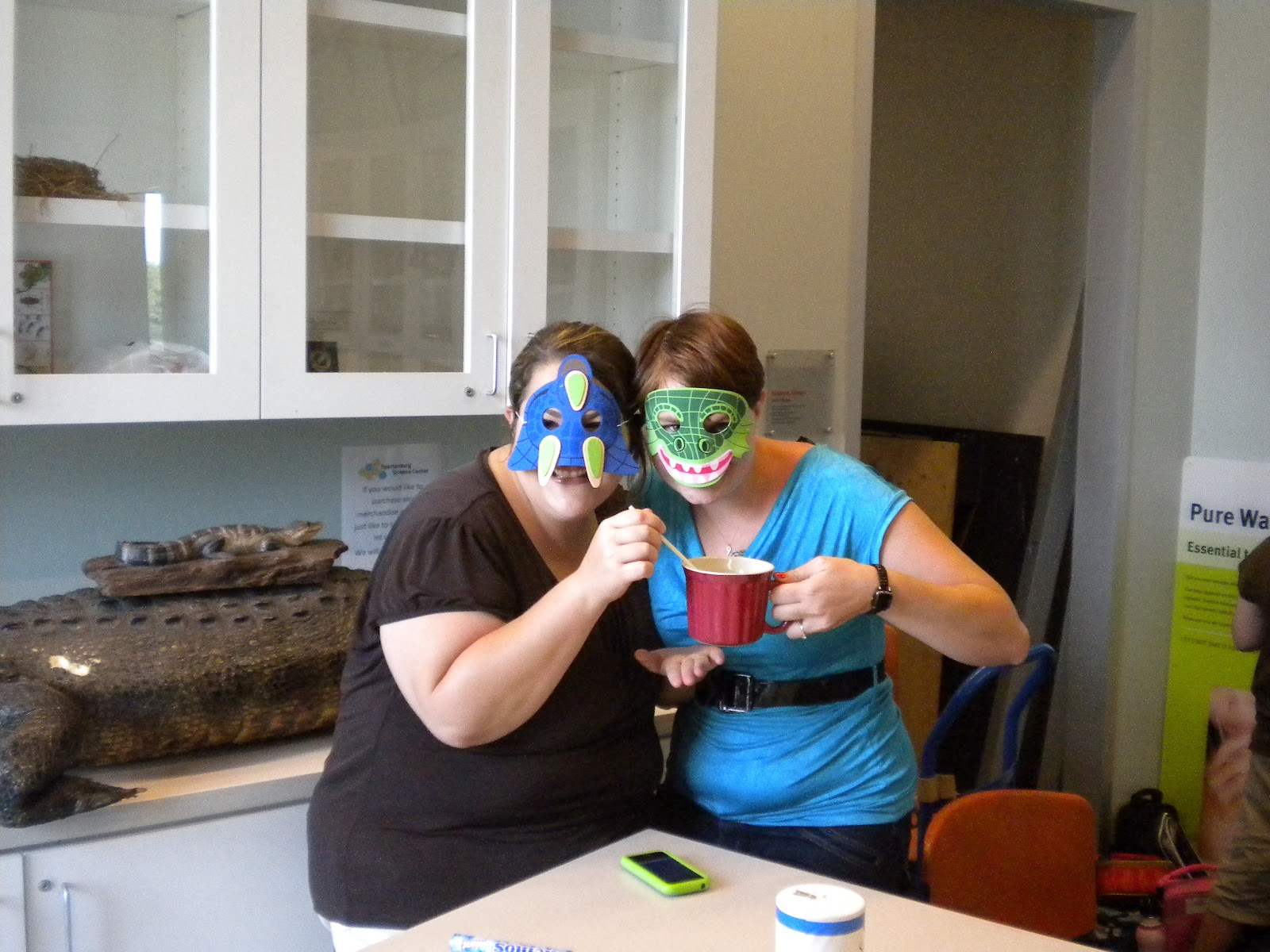
Shanda and I are goofing around here.  We found these masks among other  supplies.
For example, we were talking about evaporation.  Shanda, a teacher I'm working with, posed the question "What happens if you add food coloring to water and let the water evaporate?  Does the food coloring stay in the cup or does it evaporate too?"  We were not sure of the answer and we had a discussion with the kids.  During the next break when the kids had some play time we realized that we had all the components to concoct an experiment.  In the discussion I pointed out that if you boiled sea water, you would be left with salt.

Our experiment was set up like this:  we put water, salt and blue food coloring into a ceramic mug.

Regular table salt and blue water.  Plus you can see that I took off my mask.
I then heated the mug on a hot plate to expedite the evaporation process.

Boiling blue salt water!  Next is a video if you are interested.

 We determined that we could make blue salt!  The kids thought this was very cool. 
 We had a lot of fun with this.  (Well I did at least!)  Soon we will be doing some crafts with the kids.  Hopefully I will get some good pictures of that.


I will answer the second question that I proposed soon.  I just wanted to share this first.  Again, my schedule has gotten away from me but I'm enjoying every minute of it.

I can't wait for tomorrow at camp.  Night everyone!